Last Updated – September 2026
As a mobile sports massage therapist in York, I treat a lot of clients with calf pain and tightness.
The calves take a huge amount of load during walking, running, training, and even prolonged standing or sitting. When they become tight or restricted, the result can be aching, sharp pain, reduced ankle mobility, or problems that travel up into the knees, hamstrings, or lower back. Many people try stretching, but once the muscles are tight, this often gives only temporary relief at best.
With qualifications in massage and Advanced Personal Training, I take a targeted approach that releases the calf muscles properly and looks at how they are interacting with the rest of the lower leg and kinetic chain. In this article, I explain the most common causes of calf pain I see and how I treat them with sports massage at your home in York.
Table Of Contents
What Is The Calf
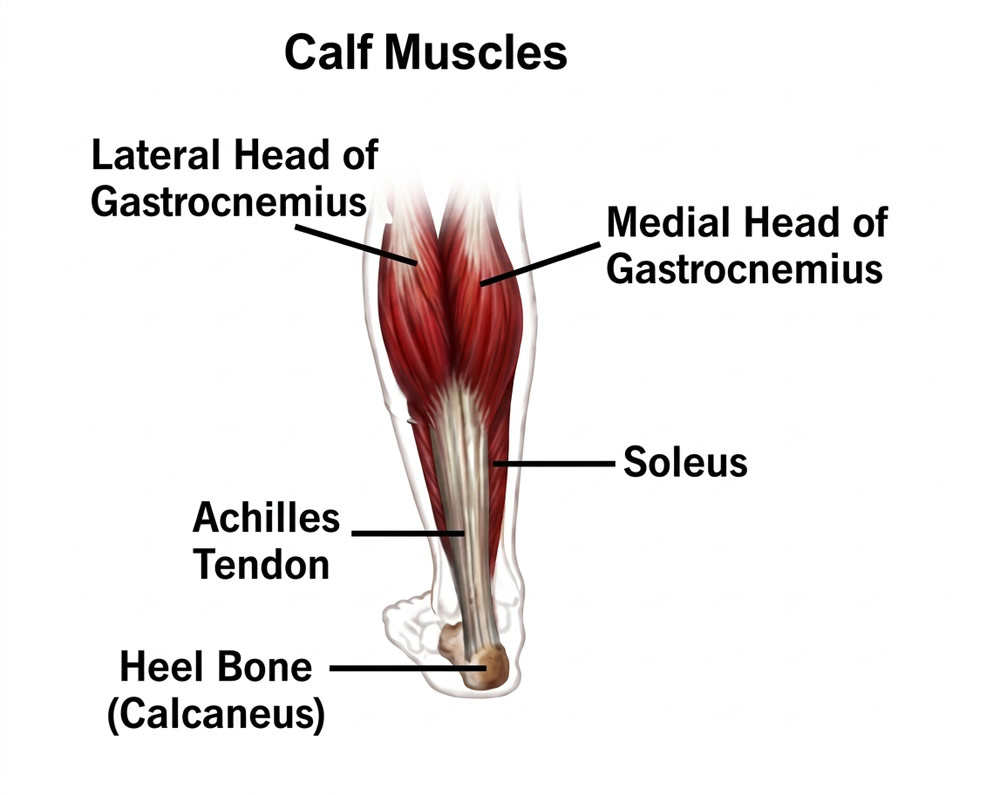
The calf is made up of two main muscles at the back of the lower leg: the gastrocnemius and the soleus. Together they form a powerful unit that plays a major role in walking, running, jumping, and almost every movement that involves the ankle and foot.
The gastrocnemius is the larger, more visible muscle. It has two heads and crosses both the knee and the ankle joint. This means it is involved in bending the knee as well as pointing the foot (plantarflexion). Because it crosses two joints, it is particularly prone to tightness and strain, especially in people who run, play sport, or spend a lot of time on their feet.
The soleus sits underneath the gastrocnemius. It only crosses the ankle joint, so its main job is to control and produce plantarflexion. It is heavily involved in standing, walking, and endurance activities. The soleus is often overlooked, but it is a very common source of deep calf tightness and fatigue.
Both muscles join together lower down to form the Achilles tendon, which attaches to the heel bone. This means any restriction or overload in the calf muscles can also affect the Achilles and the way force is transferred into the foot.
In everyday life the calves are working almost constantly. They help push you forward when walking or running, control the lowering of the heel when going downstairs, and stabilise the ankle on uneven ground. When they become tight or fatigued, the effects are rarely limited to the lower leg. Restricted calf muscles commonly alter ankle mobility, change the way the knee tracks, and force the hamstrings, glutes or lower back to compensate.
This is why calf problems so often appear alongside other issues higher up the chain, and why treating them thoroughly is important for both local pain relief and overall movement quality.
Calf pain most often starts with tightness in the muscles themselves. Prolonged sitting keeps the calves in a shortened position for long periods, gradually reducing their length and flexibility. Walking (especially in hard shoes or high heels), running, and sports that involve repeated push-off then place extra load on already restricted tissue. Over time the calves become tight, less resilient, and more prone to aching, sharp pain, or injury.
In many of the clients I see, this general tightness is the underlying foundation that then allows other problems such as strains, DOMS, or nerve-related pain to develop more easily.
How I Treat It
When calf pain is caused just by tightness, I use targeted sports massage to release both the gastrocnemius and the deeper soleus. I work along the full length of the muscle and into the Achilles region where restriction often builds. Improving the length and quality of the tissue reduces the constant pull on the ankle and lower leg and frequently eases the aching or tight sensation within a few sessions.
I also check how the calves are interacting with the hamstrings, glutes and lower back, because tightness rarely stays isolated. Where needed I release those related areas as well so the improvement lasts longer.
Calf Pain From Muscle Strain Or Tear
A calf strain or tear usually comes on suddenly. It often happens during running, accelerating, jumping, or pushing off hard, but it can also occur during something as simple as walking up stairs if the muscle is already tight and restricted. The pain is typically sharp and localised. Bruising may appear over the following days, and the muscle will feel weak and unable to stretch fully until it has healed.
These injuries are much more likely when the calf has been chronically tight or fatigued beforehand. The tissue simply has less capacity to absorb sudden load.
How I Treat It
In the first 48–72 hours after a strain I advise relative rest and ice to settle the initial inflammation. Once that acute phase has passed, I begin careful sports massage around the injury site and the surrounding tissue. The aim is to support healing, reduce protective tightness in the rest of the calf, and limit excessive scar tissue that can leave the muscle feeling tight long-term.
I also release the opposite calf and the related muscles higher up the chain (hamstrings and glutes) because the body often compensates and creates secondary tightness. Treatment is always adapted to the severity of the strain as more serious tears need longer before deeper work is appropriate. Many clients regain comfortable walking and light activity significantly faster once the surrounding tension is properly addressed.
Calf Pain From Delayed Onset Muscle Soreness (DOMS)
DOMS is the widespread muscle soreness that appears 24–48 hours after activity the calves are not used to. Common triggers include starting a new running programme, suddenly increasing walking distance, hill work, or a harder training session than usual. Unlike a strain, the discomfort is usually felt through a large part of the muscle rather than at one sharp point, and it gradually eases over the following few days.
Calves that are already tight or restricted tend to develop more severe DOMS because they have less capacity to handle the extra work.
How I Treat It
When someone comes in with calf DOMS, I use moderate sports massage to improve circulation and reduce the residual tightness that builds up after the session. The pressure is kept comfortable as the goal is to help the tissue recover rather than add more stress. Releasing both the gastrocnemius and soleus, along with any protective tension in the Achilles area, usually helps the soreness settle faster and restores normal walking comfort sooner.
I also look at how the rest of the lower leg and posterior chain are responding. Often the hamstrings or glutes tighten in response to calf soreness, so addressing those areas prevents the problem from lingering or spreading. Many clients find that regular maintenance massage reduces how severely they experience DOMS when they increase their training load.
Calf Pain Caused By Sciatica
Not all calf pain originates in the calf itself. The sciatic nerve runs from the lower back, through the glutes and hamstrings, and down into the lower leg. When this nerve is irritated, the pain can be felt in the calf even though the source of the problem is higher up.
Tight or inflamed calf muscles can sometimes add local pressure on the nerve, but more often the real driver is restriction in the lower back, glutes or hamstrings. In these cases, treating only the calf gives limited or temporary relief because the nerve is still being affected further up the chain. This is a pattern I see regularly, where clients come in complaining of calf pain, yet the main restriction is found in the glutes or lower back.
How I Treat It
When calf pain appears to have a nerve-related component, I assess the entire chain: lower back, glutes, hamstrings and calves. I release the local calf tightness to reduce any secondary restriction, then work thoroughly on the areas that are actually irritating the nerve, whic is most commonly the gluteus medius, piriformis region, hamstrings and the muscles around the lower back.
By addressing both the local symptoms and the source higher up, the referred pain into the calf usually settles more effectively. Many clients notice the calf feels freer once the tension is properly released. I always adapt the treatment according to how irritable the nerve appears to be on the day.
How Calf Pain Can Cause Other Issues
Tight or painful calves rarely stay isolated. Because the gastrocnemius crosses the knee joint and both calf muscles strongly influence ankle mobility, restriction here often changes the way you move higher up the chain.
A common example is during squatting or lunging. Limited ankle dorsiflexion from tight calves causes the heels to lift or the knees to track poorly. This shifts load into the knees, hips or lower back and can create secondary pain in those areas.
Calf tightness can also contribute directly to discomfort at the back of the knee, as the upper fibres of the gastrocnemius blend into that region. In runners and active people, restricted calves frequently force the hamstrings and glutes to overwork, which can lead to tightness or pain further up the posterior chain.
This is why I always look beyond the local symptoms. Releasing the calves often improves movement quality and reduces strain on the knees, hips and lower back at the same time.
Frequently Asked Questions
Yes. The calves respond particularly well to targeted sports massage. Both the larger gastrocnemius and the deeper soleus can become restricted, and once they do, stretching alone often only gives short-term relief. By releasing the tissue thoroughly and improving its quality, most clients notice the calves feel looser, lighter, and less prone to aching within a few sessions.
Tightness tends to develop gradually and feels like a constant restriction or dull ache through the muscle. A strain usually starts suddenly during activity, feels sharper and more localised, and may be accompanied by bruising or clear weakness. If you’re unsure which one you’re dealing with, I can assess it during the session and adapt the treatment accordingly.
Yes. Restricted calves reduce ankle mobility and force other muscles to work harder with every step. This often leads to earlier fatigue, altered stride mechanics, and increased load on the Achilles, knees or hips. Many runners and active walkers notice that once the calves are properly released, their lower legs feel freer and recovery between sessions improves.
Yes. Limited ankle mobility from tight calves changes the way force travels through the lower limb. This can cause the heels to lift during squatting or lunging, alter knee tracking, and force the hamstrings, glutes or lower back to compensate. Many clients find that improving calf mobility reduces secondary strain further up the chain and makes other movements feel easier.
No. Although the calves are the focus when they are the main source of symptoms, I always assess the related areas. The hamstrings, glutes, opposite leg, and sometimes the lower back commonly contribute to or are affected by calf problems. Treating the wider pattern produces more complete and longer-lasting results than working on the calves in isolation.
It depends on the cause and how long the problem has been present. Simple tightness from daily activity or training often improves noticeably in 2–4 sessions. A recent strain or longer-term restriction usually needs a short course of treatment to restore proper length and resilience. After the first session I can give you a clearer idea of what to expect based on what I find.
It depends on the type and severity of the pain. Mild tightness can often be trained around with reduced volume or adjusted exercises. Sharp pain, swelling, bruising, or a clear strain needs more caution and usually a short period of modified activity. During the session I can assess what is realistic and give you practical guidance on what to avoid or adapt.
Gentle stretching can be useful, but when the muscles are significantly tight or have residual restriction from previous loading, stretching frequently fails to create lasting change. Massage first improves the condition of the tissue, after which the right mobility work becomes much more effective. I can show clients specific stretches and movements they can do at home to support the results.
Summary
Calf pain can come from simple tightness, a strain, DOMS, or referred nerve irritation from higher up the chain. In many cases more than one factor is involved.
My approach is to identify the main driver, release the restricted tissue thoroughly, and address any related areas that are feeding the problem. This produces more complete and longer-lasting relief than treating the calf in isolation.
If you’re dealing with ongoing calf pain or tightness and would like a targeted mobile treatment, book a massage at home today.
Book A Mobile Massage
If you would like to book a mobile massage in York please contact me on 07713 250352 or email david@massageinyork.co.uk. Includes sports massage, deep tissue massage and Swedish massage. For more information on booking click here

Hướng dẫn massage bắp chân hiệu quả, cảm ơn thông tin chia sẻ hữu ích
Effective calf massage instructions, thanks for sharing useful information
So I’m contemplating on getting physio. My injury happened on a hard court playing basketball. After about an hour or so I started to feel tightness, kinda like a strain. This was about 3 weeks to 1 month ago. I still have the pain mainly cause I’m stupid and play TRL which is a full on running stop starting sport and play every Wednesday. When I play (just before I start playing) we warm up kicking the ball this that. No pain at all mainly cause I compress it. But the pain then comes when I get into the game I get this sharp almost crippling pain in the middle of my right calf and it’s deep but I continue to play anyways. It’s been like I said 3 weeks at least. Walking doesn’t hurt too bad it’s just the palm of my foot right where my toes begin that’s where I’ve found the pain to be stemming from. So not where the big toe is but around the 3rd and 4th toe, when I press just around there at the palm of the foot where the toes start(not toe nail but at the base your my toes) or try put pressure it kills mainly cause I think I’ve not let it heal properly. My question is why is it that I can almost do every other daily task fine with maybe little stretches of pain but then it’s ok once I start walking, why is it when I get into my TRL that it kinda feels like a stitch you get when you’re unfit up just for the middle of the calf why does this pain stay and will physio help heal and strengthen?